Plastering · Bricklaying · Tiling · Floor paving
Issue by the flat,
counted first
A plasterer glances at the drawings and already knows roughly how many tiles and bags a flat will take. This page lays that arithmetic out: pick the flat, the tile size and the wastage, and watch the issue slip build. What materialpro does comes next — record each issue flat by flat and compare it with what was bought.
- Plastering
- Bricklaying
- Wall tiling
- Floor paving
Illustrative calculator
Flat issue slip
Typical start 8%
Issue slip
550 sq ft flat · 600×600 mm · Straight · 8% wastage
- Tiles4 pcs/box
- 55boxes
- 780 sq ft ÷ 3.875 sq ft/pc = 202 pcs
- add 8% wastage → 219 pcs
- ÷ 4 pcs/box → 55 boxes
- Tile adhesive20 kg bag
- 19bags
- 780 sq ft ≈ 72.5 m²
- × 5 kg/m² = 363 kg
- ÷ 20 kg/bag → 19 bags
- Cement50 kg bag
- 16bags
- plaster 1,200 sq ft ≈ 111.5 m²
- × 7 kg/m² = 781 kg
- ÷ 50 kg/bag → 16 bags
- Sand25 kg bag
- 94bags
- plaster 1,200 sq ft ≈ 111.5 m²
- × 21 kg/m² = 2,342 kg
- ÷ 25 kg/bag → 94 bags
Assumed for a 550 sq ft flat: floor tiles 440 sq ft, wall tiles 340 sq ft, plastering 1,200 sq ft
This is an illustrative calculator showing how a foreman reasons about one flat — it is not a materialpro feature. Rates and pack sizes are for demonstration; use your drawings, supplier specs and site experience.
What does the calculation assume?
- Floor and wall use the same tile. Pieces per box are typical packs; check your supplier's spec.
- Plastering is a 1:3 cement–sand mix about 15 mm thick: 7 kg of cement and 21 kg of sand per m².
- Tile adhesive per m² rises with tile size: 4 kg at 300, 5 kg at 600, 6 kg at 800.
- Everything rounds up to whole boxes and bags. No extra wastage is added to cement or sand.
Four jobs under one trade
Same trade, four different ways of buying
From first coat to last grout line, a flat goes through four kinds of work. Different materials, different units, different places to lose count.
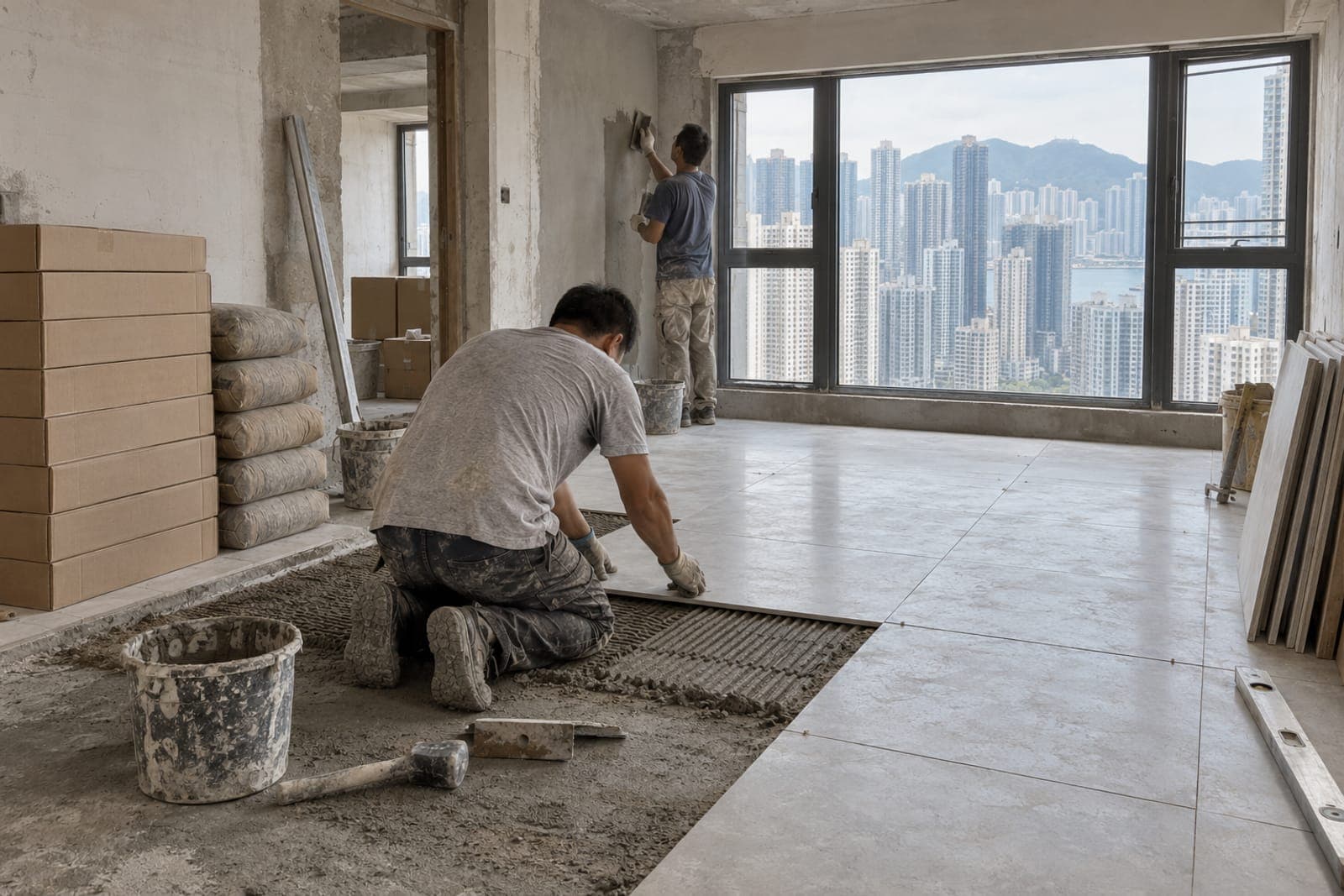
Base coat & plasteringCement–sand render to walls and soffits
- Main materials
- Cement, sand
- How it is counted
- Estimated from wall and ceiling area (sq ft); cement and sand issued by the bag
- Where counts leak
- Deliveries arrive in batches, yet nobody can say how much each flat used
BricklayingBlock walls and partitions
- Main materials
- Blocks, cement, sand
- How it is counted
- Blocks by piece, bulk loads by pallet; mortar materials by the bag
- Where counts leak
- Breakage, handling loss and wall changes pull real use away from the drawings
Wall tilingKitchen and bathroom walls
- Main materials
- Tiles, adhesive, grout
- How it is counted
- Bought by the box, laid by the piece, quoted by the square foot
- Where counts leak
- Dye lots differ in shade, which makes top-ups painful; cutting loss shifts with size and layout
Floor pavingLiving, dining and bedroom floors
- Main materials
- Floor tiles, adhesive or sand–cement bed, grout
- How it is counted
- By floor area per flat; tile boxes issued flat by flat
- Where counts leak
- Large tiles and diagonal layouts waste more — one extra box per flat is six extra boxes a floor
One tile, four ways to count it
The boxes you bought are not the pieces the tiler lays
The supplier's delivery note says boxes, the tiler lays pieces, the subcontractor quotes per square foot and the drawings say square metres. Whoever reconciles has to convert in between.
Sample data for illustration
- Bought
55
boxes
Supplier quote, delivery note
ordered from the issue slip
- Laid
220
pieces
Tiler and foreman, wastage
55 boxes × 4 pcs/box
- Quoted
852.5
sq ft
Rate per sq ft, valuations
220 pcs × 3.875 sq ft/pc
- Drawn
79.2
m²
Specifications, supplier price lists
852.5 sq ft × 0.0929
Every material carries its own unit
Purchase orders, receiving and stock are recorded in the unit set for each material. How boxes, pieces and square feet convert can be walked through in a demo against the way you work.
Issue progress
A whole block, one square per flat
Each square is the number of tile boxes already issued to that flat. The standard is set at 600×600 with 8% wastage: 55 boxes for a 550 sq ft flat, 38 for a 350. Anything above standard turns red.
| Flat | A550 sq ft | B550 sq ft | C550 sq ft | D350 sq ft | E350 sq ft | F350 sq ft |
|---|---|---|---|---|---|---|
| 11/F | 55 | 55 | 55 | 38 | 38 | 38 |
| 10/F | 55 | 55 | 59+4 | 38 | 38 | 38 |
| 9/F | 55 | 55 | 55 | 38 | 40+2 | 38 |
| 8/F | 55 | 55 | 55 | — | — | — |
| 7/F | — | — | — | — | — | — |
- Issued to standard
- Above standard
- Not yet issued
Sample data for illustration · Floors or flats can be set up as warehouses. Issues post to the stock ledger as transfers and can be traced line by line.
- Bought
- 1,100boxes
- Issued
- 1,008boxes
- of which above standard
- 6boxes
- In store (book)
- 92boxes
- Still needed by open flats
- 393boxes
- Short by
- 301boxes
Set against what is in store, the gap is clear early enough to raise a requisition before the tiles run out.
Everyday on a plastering subcontract
Five things the boss hears every week
“We bought so many boxes and issued them to who knows which flats — checking floor against floor turns into a mess.”
Set up the site store and each floor as warehouses and record every issue as a transfer. Where each box went is in the stock ledger.
Multi-warehouse · transfers · stock ledger
“Cement and sand arrive by the load. Which flat is using far more than the rest?”
Issues post by warehouse and material, so you can view the cement, sand and tiles issued per floor or flat and spot the one running high.
Stock ledger
“The supplier says they delivered the full count, and we only find it short at the check.”
Site photographs the delivery note; AI extracts items and quantities and matches the PO, listing shortfalls and variances straight away.
Delivery notes · PO matching
“Tile shop and cement supplier each quote in their own format, and comparing means copying by hand.”
Request the same items from several suppliers; AI helps read each quotation, lays them side by side and converts the winner to a PO. Suppliers can also quote through a link.
RFQ · quote comparison
“The invoice lands and the box count doesn't match what we received.”
Invoices are checked three ways against the PO and the receiving record, and price or quantity variances come to you before payment.
Three-way invoice check
Trade vocabulary
Words you hear among Hong Kong plasterers and tilers
Quotes, issues and reconciliations all revolve around these terms.
- 泥水
- Umbrella term for the wet trades — plastering, bricklaying, tiling. The Labour Department's trade name is 泥水工.
- Plastering, bricklaying and tiling
- 打底・批盪
- A base coat of cement–sand on walls and soffits, then a levelled finishing coat. Plastering is a designated trade under the CIC specialist contractor scheme.
- Plastering / rendering
- 紅毛泥
- The old name for cement, still used by veteran tradesmen. Bought and issued by the bag.
- Cement
- 箱・片・呎
- Tiles are bought by the box, laid by the piece and quoted by the square foot — three numbers for the same tiles on three documents.
- Box · piece · sq ft
- 損耗
- Tiles lost to cutting, breakage and patching. Higher for large tiles and diagonal layouts; there is no universal percentage.
- Wastage / cutting loss
- 缸號
- The firing-batch number of a tile. Different dye lots can differ in shade, so watch it when topping up.
- Dye lot / shade batch
- 正鋪・斜鋪
- Tiles laid square to the wall, or turned 45 degrees. Diagonal means more edge cuts and more wastage.
- Straight / diagonal layout
- 瓷磚膠
- Adhesive for fixing tiles, bought by the bag. Use varies with tile size and how flat the base is.
- Tile adhesive
- 單位發料
- Issuing tiles, cement and sand flat by flat from the site store to the plasterers.
- Material issue to flat
- 呎價
- A labour or material rate per square foot, common in plastering subcontract quotes.
- Rate per sq ft
FAQ
What plastering and tiling contractors ask first
Is the flat issue calculator on this page a materialpro feature?
No. It is an illustrative calculator showing how a foreman reasons about one flat, and its rates and pack sizes are only for demonstration. What materialpro does is the record that follows: issues, returns and transfers post to the stock ledger and are compared with what was bought.
Tiles are bought by the box, laid by the piece and quoted per square foot. How does the system cope?
Each material can have its own unit of measure, and purchase orders, receiving and stock are recorded in that unit. How boxes, pieces and square feet convert depends on how you set the material up, and we can go through it against your own method in a demo.
Can each flat be treated as a warehouse?
Yes. The site store, each floor or even each flat can be a warehouse, with issues recorded as transfers you can trace line by line. How fine to go depends on how closely you want to track; recording down to the floor is fine too.
What wastage allowance is reasonable?
There is no universal figure. It depends on tile size, layout, how square the walls are and the tiler's hand. materialpro does not set wastage for you, but it keeps the quantities actually issued and returned, so the next project has your own history to compare against.
How are delivery notes and invoices checked?
Site staff photograph the delivery note; the system extracts items and quantities and matches the PO. Invoices are then compared with the PO and receiving record, and price or quantity variances are listed for your review before payment.
On the same project