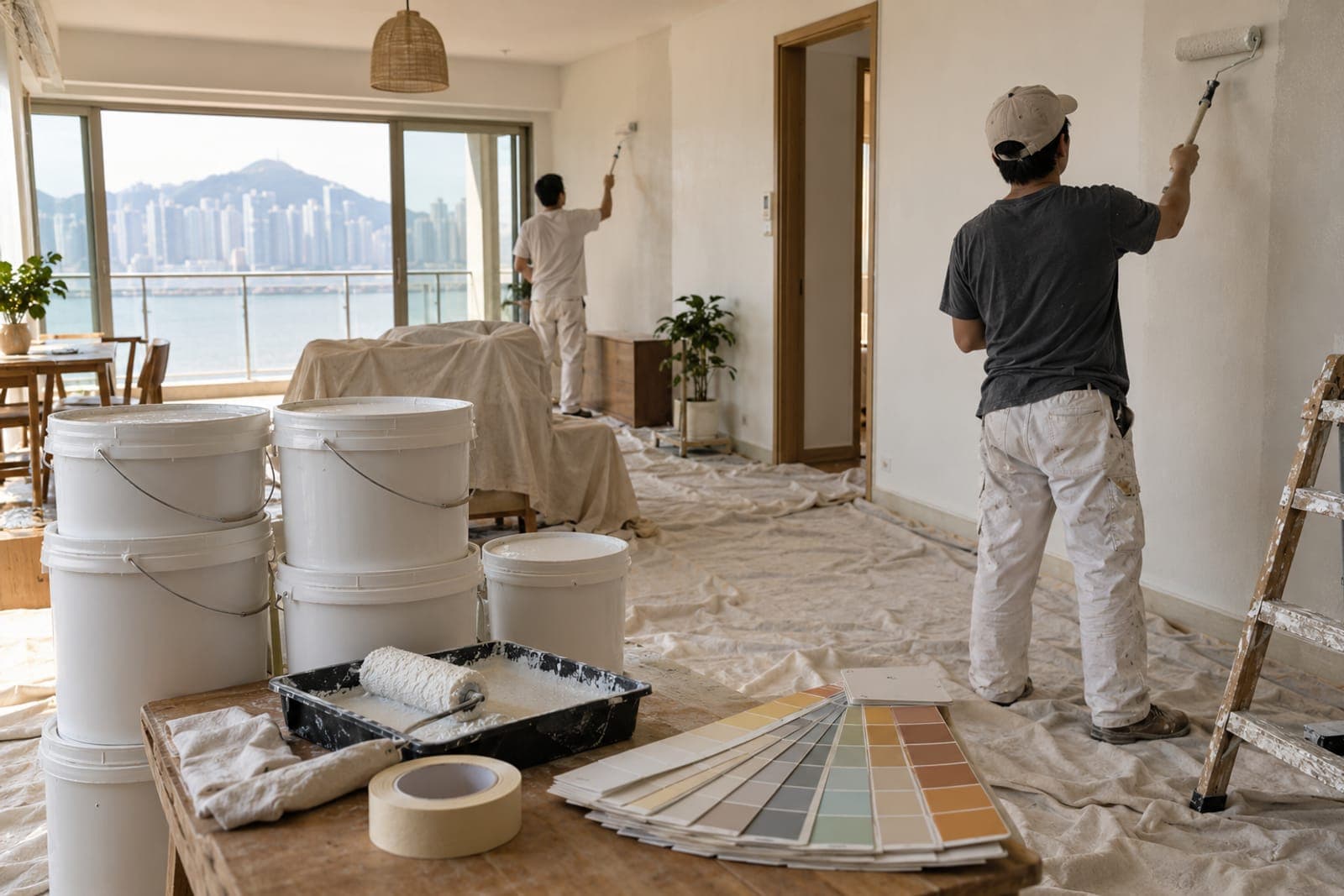
Painting · Skim coat · Primer · Finish
Colour codes match,
litres add up
The same colour code tinted in two batches can come out slightly different, and a flat painted from both batches shows. materialpro ties requisition, quote, delivery and invoice together, so you can see how much of each colour was bought, received and used.
- Skim coat
- Emulsion
- Tinted colours
- Touch-up leftovers
- 1Skim coat
- 2Primer
- 3Finish coat
Three coats, three ways of buying
Skim coat, primer and finish are bought differently
How much paint a flat takes starts from wall area: square feet × coats ÷ coverage per litre, then rounded up to whole pails.
- Wall
- Skim coat
- Primer
- Finish, coat 1
- Finish, coat 2
- 1
Skim coat
Levels the wall; sanded before priming
- What you buy
- Skim-coat powder or ready-mixed putty, sandpaper, mesh tape for crack repair
- How it is counted
- By square foot; one or two passes depending on how flat the wall is
- Where it goes wrong
- Rain and humid spells stop it drying, so sanding waits; if it is left out of the count, primer and finish soak up extra paint
- 2
Primer
Seals the surface so the finish takes evenly
- What you buy
- Primer or sealer, bought by the pail
- How it is counted
- Usually one coat; square feet ÷ the coverage on the product data sheet
- Where it goes wrong
- Freshly skimmed walls are thirsty; under-buy primer and the finish coat pays for it
- 3
Finish coat
Emulsion, tinted to a colour code
- What you buy
- Emulsion in pails for whole flats and small tins for feature walls; one order line per colour code
- How it is counted
- Square feet × coats ÷ coverage per litre, rounded up to whole pails
- Where it goes wrong
- Tinting is done in batches and two batches can differ slightly; one flat painted from both is the classic problem
- +
Touch-up leftovers
Snagging and pre-handover repairs
- What you buy
- One tin of same-batch leftover per colour, not ordered separately
- How it is counted
- Kept by colour code and batch, booked into stock
- Where it goes wrong
- Leftovers end up scattered across flats; touch up from another batch and the repair shows more than the scuff
Colour batch tracker
Which colour, which batch, which flat, in one view
An illustrative screen: for each colour code, pails received, which batches they came from, litres expected against litres used, and how a flat painted from two batches could be flagged.
Sample project · Residential refurbishment · 8 flats on floors 10 and 11
Sample data for illustration
Terracotta T-507
Entrance feature wall · 4 flats
About 1,300 sq ft × 2 coats
- Received
- 8 tins
- 40 L · 5 L pack
- Expected
- 20
- L
- Used so far
- 28.5
- L
- Leftover
- 11.5
- L
Batches
- Batch AT2410-15 tins
- Batch BT2410-33 tins
Expected vs actual litres
+42.5% · over expected- Used so far 28.5 L
- Expected 20 L
- Total received 40 L
Batch by flat
10A
Not used
10B
Not used
10C
6 L
Batch A
10D
6 L
Batch A
11A
Not used
11B
10.5 L
Batch A + B · Same colour, same batch
11C
Not used
11D
6 L
Batch B
Same colour, same batch
11B used both batch A and batch B (T2410-1 / T2410-3). Two batches side by side in one flat can show as a colour mismatch.
Flat 11B was painted from batch A and batch B, one wall was repainted, adding about 5 litres, and use ran over expected by more than 40%.
Sample assumption: about 130 sq ft per litre, two finish coats
A screen for illustration, showing how colour code, batch and litres can be reconciled. How batch codes are recorded and displayed can be worked through in a demo, around the way you work.
Old problems in painting
Four things painting contractors run into
“Same colour code, two batches, and one wall in the flat is darker than the other.”
Site staff photograph the delivery note; AI extracts items and quantities and matches the PO. Which colour came in, how many pails, and on what day is easy to look up.
Delivery matching“I need the same batch for touch-up, but the leftovers are scattered across the flats.”
Set each site or yard up as a warehouse and each colour code as an item. Receipts, issues and returns post to the stock ledger, so you check the balance before you touch up.
Stock ledger“Tinted paint can't go back once it's mixed, so buying too much or too little costs us.”
The requisition names the colour code and number of pails. Request quotes from several suppliers; AI reads each quotation and lays them side by side before you convert one to a PO.
Compared quotes“The invoice arrives and the pails and unit price don't match what we took in.”
The invoice is checked against the PO and the receiving record. Price or quantity differences are listed for your review before payment.
Three-way check
Humid spells and rain
When the weather turns, delivery dates must move too
Skim coat has to dry before sanding, and primer before the finish. On humid or rainy days every drying gap gets longer. Below is a sample schedule for one flat.
- Finish paint on site
- Day 6
- Flat complete
- Day 8
When the finish-paint date moves, the supplier's delivery date has to move with it, or the paint sits on site for extra days, takes up space and gets borrowed by other flats. The expected delivery date on each PO can be viewed in the delivery calendar.
Sample day counts for illustration; real drying times follow the product data sheet and site conditions
Skim coat
Material on site · Day 1
Skim-coat powder, sandpaper
Primer
Material on site · Day 4
Primer
Finish, coat 1
Material on site · Day 6
Finish paint (by colour code)
Finish, coat 2
Material on site · Day 8
Same-batch finish paint
Trade vocabulary
Words you hear on a Hong Kong painting job
Quotes, orders and reconciliation all revolve around these terms.
- 批灰
- Levelling the wall with skim-coat powder or putty, then sanding before primer; usually quoted as its own rate per square foot.
- Skim coat / wall putty
- 底漆
- The sealing coat applied before the finish, so the finish takes evenly and the wall absorbs less of it.
- Primer / sealer
- 面漆
- The visible final coat, commonly done in two coats.
- Finish coat / top coat
- 乳膠漆
- Everyday term for water-based wall paint, the usual choice for interior walls and ceilings.
- Emulsion paint (water-based)
- 色卡 · 色號
- The colour and its code on the supplier's colour card. Order by code, never just 'light grey'.
- Colour card / colour code
- 調色
- Adding colourant to the paint base to match a colour code; different batches can differ slightly.
- Tinting
- 批次
- Paint tinted or made in one run, with a batch code on the tin. Keep one flat, or one wall, on one batch where possible.
- Batch / lot number
- 桶 · 罐
- The delivery units for paint. Pails for whole flats, small tins for feature walls and touch-up, marked in litres or gallons.
- Pail / tin
- 平方呎 · 呎價
- The basic unit for quoting and estimating paint; 呎價 is the rate per square foot.
- Per sq ft rate
- 補口
- Repairing scuffs and missed spots after other trades finish, using the same-colour, same-batch paint kept back.
- Touch-up
- 揮發性有機化合物
- Hong Kong sets rules on VOC content and labelling for specified categories of paint; check the label when paint is delivered.
- VOC content & labelling (Air Pollution Control (Volatile Organic Compounds) Regulation)
- 髹漆及裝飾工
- The Labour Department's construction trade name for painters.
- Painter and decorator (Labour Department trade name)
FAQ
What painting contractors ask first
Can different colour codes and batches be recorded separately?
Yes. Set each colour code up as its own item, counted in pails or litres. Every receipt, issue and return posts to the stock ledger, and you can view the balance by site or warehouse. How batch codes are recorded is something to work through in a demo, around the way you work.
How do we check tinted paint when it arrives on site?
Site staff photograph the delivery note, AI extracts items and quantities and matches the PO, and shortfalls are listed straight away. Checking the colour code and batch code printed on the tin is still done by eye.
How are touch-up leftovers managed?
Set each site or yard up as a warehouse and book leftovers in by colour code, then check the balance before touching up. If surplus goes back to the supplier, the return can be recorded too.
We quote by square foot. Will materialpro work out the litres?
It does not calculate coverage for you. You estimate litres from the product data sheet and flat area; materialpro records requisition, receiving and issues, so you can set the estimate against what was actually used.
Does materialpro replace our accounting system?
No. materialpro focuses on procurement, receiving and stock records. How it connects with your accounting system is something we can cover in a demo.
On the same project