
Formwork · Plywood · Aluminium · Reuse
Every set, every floor,
every use on record
Plywood, timber and aluminium forms are struck and re-fixed on every floor, moving between the floor, the form yard and other sites. materialpro posts each issue, strike-and-return and transfer to the stock ledger, so reuse counts and top-up timing stay on record.
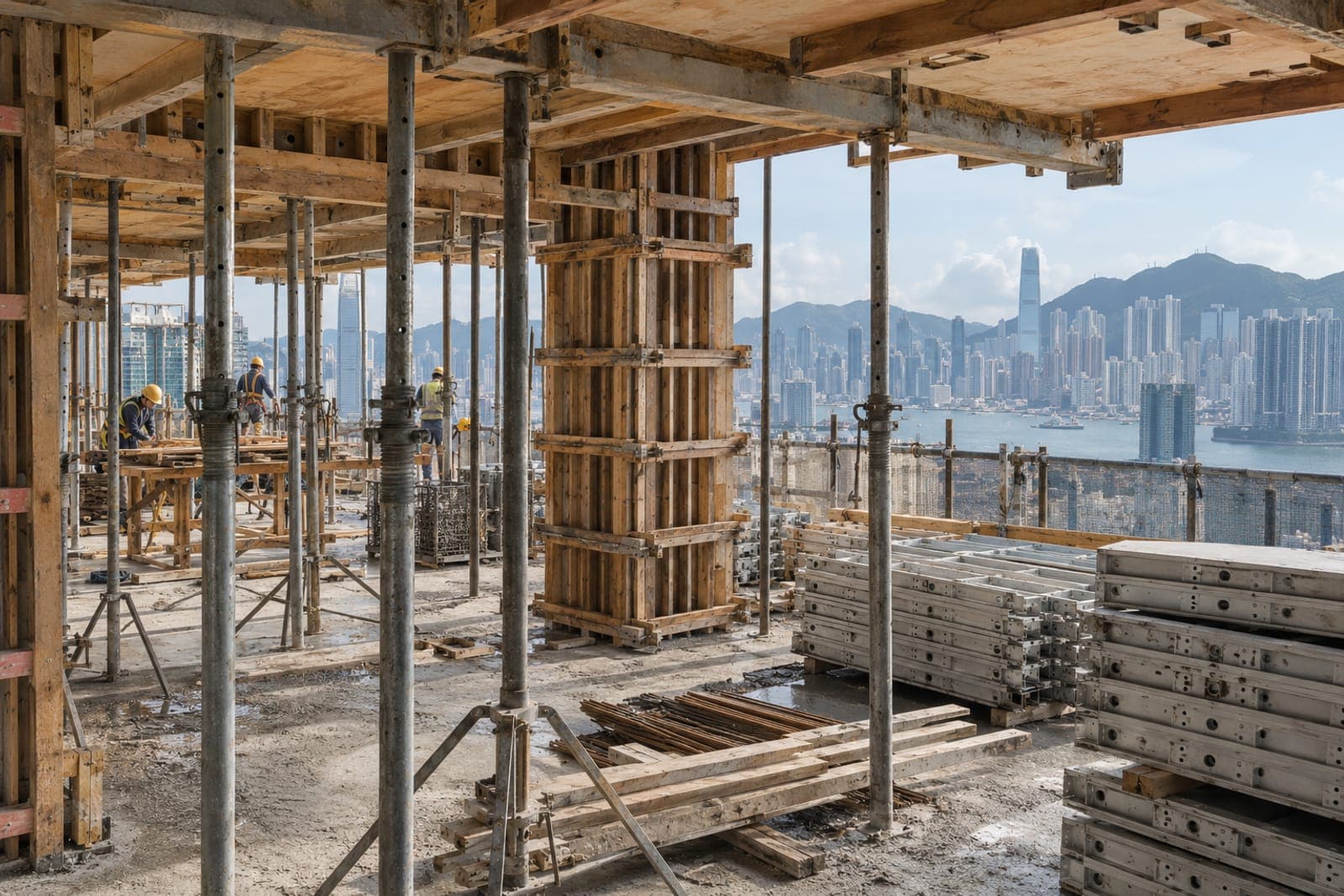
- Floor in progress
- 21/F
- Sets in place
- 3 sets
- Near limit
- Set A · Set C
Sample data for illustration
Four kinds of material
Formwork materials live very different lives
Some are used up in a pour, others go up dozens of floors. What you buy, how you count it and where it leaks all differ.
01
Plywood & timber
Plywood (incl. film-faced), timber battens
Reuse life
Limited reuse- How it is bought
- By sheet and by length from plywood suppliers and timber yards; same-day top-ups are common on typical floors
- How it is counted
- By sheet, length and batch; thickness and size are recorded separately
- Where it leaks
- Nail-holed and split sheets get scrapped without a trace, so month-end usage simply looks high
02
Aluminium forms
Aluminium panel system
Reuse life
Many reuses- How it is bought
- By set and by panel; usually bought or hired for the whole project, with extra pieces on top
- How it is counted
- By set and panel, with numbered pieces; every floor re-fixes the same set, so reuse count is where the asset value sits
- Where it leaks
- Sets move between floors and sites, and a missing or swapped piece shows up only on the next floor
03
Steel forms & props
Steel panels, adjustable steel props, soldiers
Reuse life
Many reuses- How it is bought
- By piece; often moved in from another site, with many fitting sizes
- How it is counted
- By piece and length; props are grouped by length class
- Where it leaks
- Lent out and never returned, so two sites each assume they hold it
04
Form oil & consumables
Release agent, tie rods, nails, tie wire
Reuse life
Consumed- How it is bought
- By drum, pack and piece; used up with each pour, delivered often
- How it is counted
- By drum, pack and piece; usage follows floor area and number of floors
- Where it leaks
- Many small delivery notes make line-by-line invoice checks slow
Panel reuse board
Which floor is each panel set on?
Floors run down, panel sets run across. Each cell shows which use this set is on at that floor and how far it is from its retirement limit. Select any cell to see its movements.
- Reuse progress
- Near or at limit
- Planned (not issued yet)
- Retirement limit
Sample data for illustration
| Floor | Set AWall & column formsLimit 10 uses | Set BSlab formsLimit 12 uses | Set CBeam & stair formsLimit 12 uses |
|---|---|---|---|
| 22/FPlanned | |||
| 21/FForms in place | |||
| 20/FStruck | |||
| 19/FStruck | |||
| 18/FStruck |
Select a cell to see that set's movements on that floor
Movements
Set C · 21/FUse 12 / 12
Beam & stair forms
- Use 12
Issue (Done)
Form yard21/F
Strike (In progress)
21/FWash bay
Clean, oil, return (Upcoming)
Wash bayForm yard
At limit, not re-issued (Upcoming)
Form yardTop-up requisition
This set has hit its limit and will not go up another floor. Site staff can raise a requisition for replacements, and the office can request quotes from several suppliers.
Illustrative screen: reuse counts and limits are sample settings. The stock ledger records every issue, return and transfer as the basis for counting reuse; retirement standards are set by you and the engineer in charge.
Floor-to-floor reuse
One set, one use per floor
Every few days the same set comes back to the start and goes up one floor. Each cycle has a few places that need a record.
1 / 5
Issue
The set goes from the form yard to the floor, counted by set and panel.
Issue record
How materialpro handles it
Stock transfers · stock ledger
2 / 5
Fix forms
Frame the forms, set the props, fit the tie rods. If oil or rods run short, top up the same day.
Top-up requisition · delivery note
How materialpro handles it
Requisition → delivery matching
3 / 5
Pour & cure
Concrete goes in and the forms stay put; when to strike follows the engineer's instruction.
Floor material record
How materialpro handles it
Projects · cost codes
4 / 5
Strike
Panels are checked off one by one; damage and missing pieces are noted there and then, not carried to the next floor.
Return record
How materialpro handles it
Returns · stock ledger
5 / 5
Clean & oil
Scrape, wash and oil, then back to the yard to wait. Surplus panels can move to another site.
Transfer record
How materialpro handles it
Multi-warehouse stock · transfers
On site, every week
Five things formwork bosses keep saying
- 01
“Which use is Set A on this time? Nobody remembers; we just go by what the foreman says.”
Every issue and strike-and-return posts to the stock ledger. As long as each movement is posted, how many times a set has been issued and where it went is one lookup away, not a memory test.
materialproStock ledger
- 02
“Typical-floor rush, and we are short of plywood and timber again.”
Site staff raise a requisition on their phone and the office requests quotes from several suppliers at once. AI helps read each quotation, and the winner converts to a PO.
materialproRequisition · quote comparison
- 03
“The aluminium forms came over from another site. Is the set complete?”
Each site or form yard can be its own warehouse. Transfers and returns post line by line, so the balance at both ends ties up.
materialproMulti-warehouse · transfers · returns
- 04
“Form oil and tie rods arrive in lots. How do the delivery notes ever match the invoice?”
Site photographs the delivery note, AI extracts items and quantities and matches the PO. The invoice is then checked against the PO and the receiving record, and any gap reaches you before payment.
materialproDelivery matching · three-way invoice check
- 05
“How much plywood and timber did we use this month, and on which project and cost code?”
Receipts are photographed and AI helps extract them. They are assigned to a project and cost code and reviewed by a person before they count; month-end usage reads by project.
materialproReceipts · projects · cost codes
Trade vocabulary
Words you hear on a Hong Kong formwork job
Quotes, counts and panel-set records all revolve around these terms.
- 釘板
- Building the moulds for columns, walls, beams and slabs from the structural drawings, and striking them once the concrete has set. Also the name of the trade.
- Formwork (CIC RSTCS designated trade)
- 夾板
- The usual facing material for formwork, in plain or film-faced grades. Bought by the sheet and replaced once nail holes build up.
- Plywood / film-faced plywood
- 木枋
- Timber battens that support and hold the plywood. Counted by length and sorted by section size.
- Timber batten / joist
- 鋁模
- Aluminium panel system with numbered pieces, re-used on every typical floor.
- Aluminium formwork
- 頂撐
- Adjustable steel prop holding up slab forms, grouped by length class.
- Adjustable steel prop
- 對拉螺桿
- Rod through the wall that ties the two faces of formwork together; used up with each pour.
- Tie rod
- 脫模油
- Oil applied to the panel face so it strips cleanly and lasts longer; applied each time before fixing.
- Release agent / form oil
- 標準層
- A floor whose layout repeats every few days, which is where aluminium forms pay off.
- Typical floor
- 拆模
- Removing formwork once the concrete has reached the required condition, timed on the engineer's instruction.
- Striking / stripping
- 翻板 · 周轉次數
- Cleaning struck panels and fixing them on the next floor is 翻板; how many times one set has gone round is its reuse count.
- Reuse / number of uses
FAQ
What formwork contractors ask first
Does materialpro count how many times an aluminium set has been used?
There is no built-in rule that retires a set after a number of uses. materialpro posts each issue, return and transfer to the stock ledger, and reuse can be counted from those records. When to retire a set stays your call and the engineer's.
Do we have to log plywood and timber sheet by sheet?
No. You choose how fine the record is: by sheet, length or batch, or by size class. Each material has its own unit of measure, and movements are recorded per site or warehouse.
How do we record a panel set moving from one site to another?
Set each site or form yard up as a warehouse. Make a transfer when the set leaves and a return when it comes back. The balance at both ends and every movement stay in the stock ledger.
Can we compare prices quickly when plywood runs short on a rush floor?
Site staff raise a requisition on their phone, the office requests quotes from several suppliers, suppliers can submit through a link, and AI helps read each quotation. The chosen quote converts straight to a PO.
How are supplier delivery notes and invoices checked?
Site photographs the delivery note; the system extracts items and quantities and matches the PO. Invoices are then compared with the PO and receiving record, and price or quantity variances are listed for your review before payment. How materialpro connects with your accounting system is something we can cover in a demo.
On the same project