

AI in construction procurement has moved from document OCR to workflow intelligence. Here is what works in 2026, where humans still decide, and how contractors can roll it out safely.
Key takeaways
- AI in construction procurement works best as a control layer: it reads, matches, flags, summarizes, and recommends while humans approve commercial decisions.
- The highest-confidence use cases in 2026 are supplier document extraction, three-way matching, quote normalization, demand signals, and policy-assisted workflow routing.
- The safest rollout starts with one document type in shadow mode, moves to assisted review, then expands into exception routing and decision intelligence.
- AI value depends on connected procurement data: requisitions, RFQs, POs, delivery records, inventory, invoices, projects, cost codes, and suppliers.
- Measure AI by minutes saved, first-pass match rate, exception resolution time, touchless data capture, spend under control, and supplier response cycle time.
Quick answer: AI is changing construction procurement in 2026 by converting messy supplier and site information into structured buying workflows. The practical value is not a robot buyer replacing procurement people. The value is faster document reading, cleaner quote comparison, earlier risk signals, better three-way matching, and fewer blind spots between requisitions, purchase orders, deliveries, invoices, inventory, and project budgets.
The best procurement teams are using AI as a control layer: it reads, matches, flags, summarizes, and recommends. Humans still approve suppliers, commercial trade-offs, substitutions, payment exceptions, and policy overrides. That split matters because construction procurement has high financial impact and real site consequences. A wrong item, late delivery, missed price variance, or invoice mismatch can delay work, consume contingency, and damage supplier trust.
This guide focuses on the AI use cases that are strong enough for contractors to adopt now, the architecture that makes them reliable, and the rollout plan that keeps the finance, procurement, and site teams in control.
What Changed In 2026
For years, AI in construction procurement mostly meant OCR demos and generic chatbots. In 2026, the useful shift is more specific: AI is becoming embedded inside procurement workflows instead of sitting beside them as a separate tool. It can read an invoice, compare it with a purchase order and delivery record, summarize the exception, draft the message to the supplier, and route the issue to the right approver.
McKinsey describes procurement as moving beyond transaction work toward a strategic driver of resilience, sustainability, speed, and innovation, with agentic AI changing what procurement functions can achieve. That framing is important for construction because procurement is not just a back-office cost center. It controls material availability, supplier responsiveness, cash leakage, carbon choices, and project continuity.
Google's 2026 guidance on generative AI search also matters for how this article is structured. Google is clear that GEO and AEO are still SEO, and that visibility depends on useful, people-first content rather than hacks. The same discipline applies to procurement AI: avoid novelty for its own sake, answer the real operational questions, and show the workflow clearly.
The Five AI Jobs That Work Best Today
AI can touch many procurement activities, but five jobs consistently create the most practical value for contractors because they reduce manual work while strengthening controls.
1. Reading Supplier Documents And Turning Them Into Structured Data

This is still the highest-confidence AI use case. Supplier invoices, delivery slips, quotations, packing lists, and receipts arrive in different layouts. Procurement and finance teams then spend time retyping line items, quantities, units, tax, delivery dates, PO references, and supplier details.
Modern AI extraction turns those documents into structured fields. The key is not just reading the PDF. The key is mapping the extracted data to the procurement record that already exists: the requisition, RFQ, purchase order, delivery, project, cost code, and inventory item.
When this is done well, the human review changes from data entry to exception review. The team checks highlighted fields, confirms uncertain values, and approves the record. That is a much better use of a procurement person's time.
2. Matching Purchase Orders, Deliveries, And Invoices
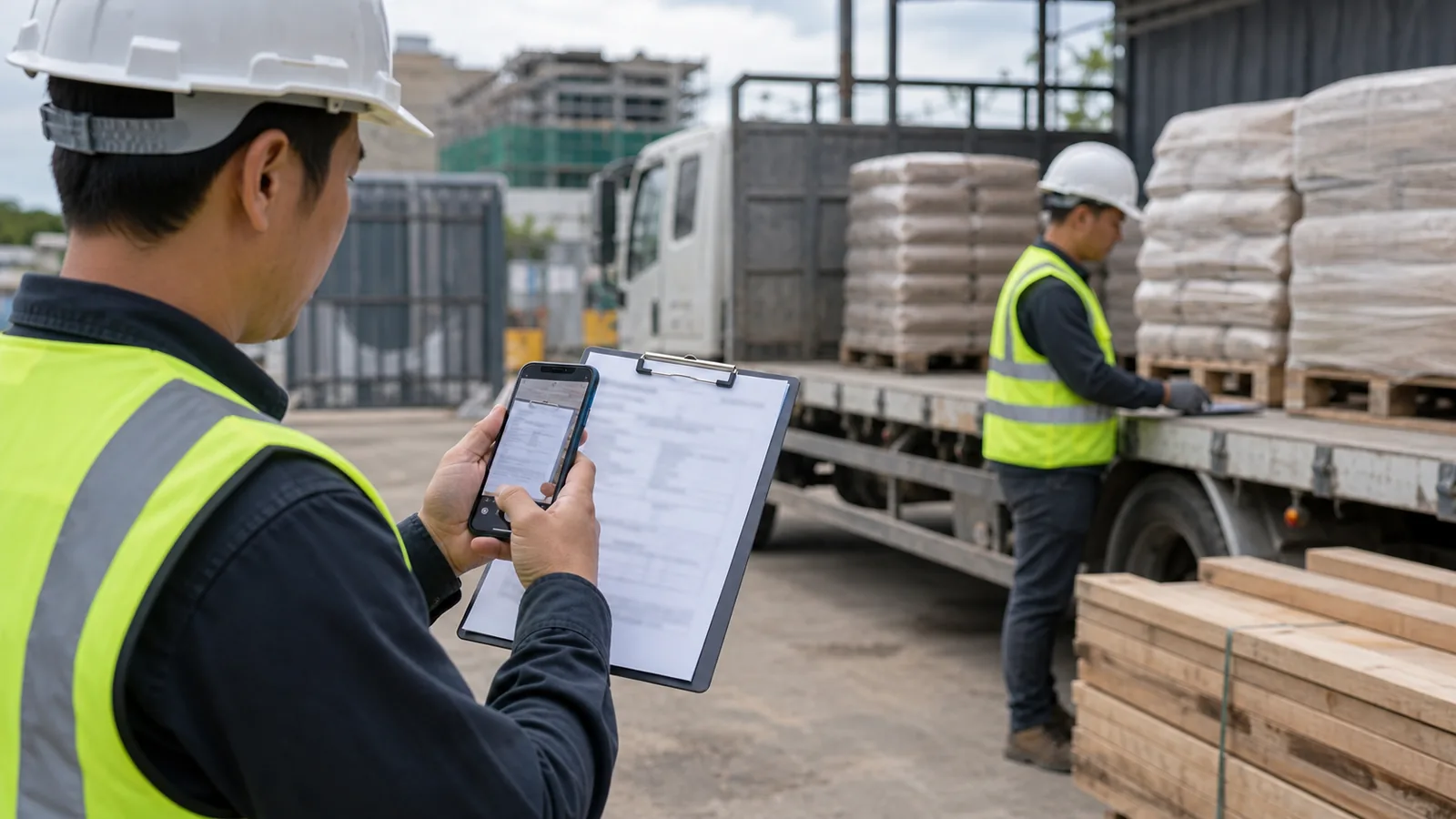
Three-way matching is where document AI becomes financial control. The system compares what was ordered, what arrived, and what the supplier billed. AI helps by reading the unstructured documents, normalizing item names, matching similar descriptions, and explaining the discrepancy in plain language.
For example, if a supplier invoice bills 120 units but the delivery record shows 100 received, AI can flag the mismatch, identify the affected line, draft the supplier query, and route it to the buyer or site team. The system should not silently approve payment. It should make the exception obvious and easy to resolve.
3. Comparing Quotes That Arrive In Different Formats
Construction suppliers do not always quote in neat templates. One may quote by pack, another by piece, another with delivery included, and another with a validity date or substitution hidden in the notes. AI can help normalize the comparison by extracting item, unit, lead time, exclusions, freight, payment terms, and validity period.
The output should not be a magical winner. It should be a comparison table with the assumptions visible. Procurement still decides whether a higher-price supplier is better because of lead time, quality, credit terms, stock certainty, or historical reliability.
4. Surfacing Demand, Price, And Supplier Risk Signals
AI is useful when it can see patterns across orders, inventory, deliveries, and supplier behavior. It can flag material categories with rising prices, vendors with increasing late deliveries, projects that are repeatedly ordering emergency quantities, and items where inventory is likely to run out before the next planned delivery.
This is where procurement moves from reactive administration to active risk management. Instead of discovering a material shortage after a site call, the team sees the risk while there is still time to consolidate demand, pre-order long-lead items, negotiate alternatives, or move inventory between projects.
5. Assisting Policy, Approval, And Supplier Communication
Procurement teams lose time explaining the same policies repeatedly: why a requisition needs another quote, why a substitution needs project approval, why a payment exception cannot move without a delivery record, or why a supplier document is missing required information.
An AI assistant can draft those explanations, summarize approval history, and prepare messages. The important guardrail is that the assistant should use the organization's actual rules, thresholds, and data. Generic procurement advice is not enough. A useful AI assistant knows the current PO, supplier, project, policy, and exception.
Where AI Should Not Be Autonomous

The right question is not whether AI should be used. The right question is where AI should stop. In construction procurement, the safest design is to let AI automate the reading, matching, summarizing, and drafting work while keeping commercial authority with accountable humans.
| Procurement decision | Good AI role | Human control that should remain |
|---|---|---|
| Invoice extraction | Read fields, show confidence, map lines to PO items | Confirm low-confidence fields and approve payment release |
| Delivery discrepancy | Flag quantity, unit, or item mismatch and summarize evidence | Accept, reject, backorder, or dispute with supplier |
| Quote comparison | Normalize prices, units, lead times, and exclusions | Select supplier based on commercial context and project risk |
| Supplier risk | Surface late delivery trends, missing documents, and price movement | Change supplier strategy, negotiate, or escalate |
| Approval routing | Recommend approver from policy, amount, project, and cost code | Override policy only with accountable approval and audit trail |
The Reference Architecture For AI Procurement
AI works only when it is connected to clean workflow data. A chatbot placed on top of scattered spreadsheets cannot reliably manage procurement risk. A strong architecture connects the following layers.
- Source documents: invoices, delivery slips, quotes, purchase orders, RFQs, receipts, supplier certificates, and approval notes.
- Structured procurement records: requisitions, PO lines, suppliers, materials, cost codes, projects, delivery records, inventory movements, and invoice lines.
- AI extraction and matching: document parsing, item normalization, duplicate detection, line matching, confidence scoring, and discrepancy classification.
- Workflow controls: approval thresholds, human review queues, audit logs, segregation of duties, and exception routing.
- Decision support: supplier performance, price movement, demand signals, stockout risk, and project-level spend visibility.
The architecture has to support both the office and the site. If a delivery slip is captured on a phone at the gate, the AI workflow should connect it back to the PO immediately. If an invoice arrives later by email, the system should already know what was received and what still needs review.
A Safe Rollout Plan For Contractors
The fastest AI procurement projects do not begin with a grand transformation. They begin with one document type, one workflow, and one measurable pain point.
Phase 1: Shadow Mode
Run AI extraction beside the existing process. Do not let it change approvals yet. Compare what the AI extracted with what the team entered manually. Measure field accuracy, exception types, and time saved per document.
Phase 2: Assisted Review
Move clean documents into an assisted review queue. The user sees highlighted fields, confidence indicators, and the matched purchase order or delivery record. They confirm or correct the output. This phase usually changes the work from rekeying to review.
Phase 3: Exception Automation
Let the system classify discrepancies and route them. A price mismatch goes to procurement. A delivery quantity mismatch goes to the site or warehouse. A tax or supplier registration issue goes to finance. AI drafts the summary, but the responsible person resolves the issue.
Phase 4: Decision Intelligence
Once enough workflow data is clean, add price movement, supplier performance, and demand forecasting. This is the strategic layer: what to order earlier, which supplier needs attention, where prices are moving, and which project is creating unplanned purchasing pressure.
Metrics That Prove AI Is Working
AI adoption should be judged by operating metrics, not by how impressive a demo looks. The most useful metrics are simple and hard to fake.
- Minutes saved per invoice or delivery slip: compare manual entry time with AI-assisted review time.
- First-pass match rate: the percentage of invoices that match PO and delivery records without manual investigation.
- Exception resolution time: how long quantity, price, tax, and missing-document issues take to close.
- Touchless data capture rate: how many documents become structured records without rekeying.
- Spend under control: percentage of project spend tied to approved POs before invoice arrival.
- Supplier response cycle time: how quickly quote questions, delivery issues, and invoice disputes are resolved.
Common Failure Modes
The biggest AI procurement failures are rarely model failures. They are workflow failures. The AI may read a document correctly, but if the purchase order is incomplete, the supplier name is duplicated, the item catalog is messy, or the approval rule is unclear, the output still creates work.
Watch for these red flags:
- AI extracts invoice lines but the platform cannot match them to PO and delivery records.
- Approvers receive AI summaries without seeing the source document and audit trail.
- The system has no way to handle partial deliveries, substitutions, backorders, or unit conversions.
- Site teams cannot capture deliveries from mobile devices, so finance still waits for paper.
- Leadership measures AI by adoption count instead of cycle time, error reduction, and exception closure.
How This Fits Construction Procurement Software
AI is strongest when it is built into the procurement system of record. If the platform already manages requisitions, RFQs, POs, deliveries, inventory, and invoices, AI can connect each document to the workflow around it. If those steps live in separate tools, AI becomes another disconnected layer.
For a platform-level evaluation checklist, read the companion guide: Construction Procurement Software: The 2026 Buyer's Guide. For the financial case, see Hidden Costs of Construction Material Procurement.
The MaterialPro View
The practical future of AI in construction procurement is not autonomous buying. It is controlled acceleration. AI should make every procurement record easier to create, every exception easier to understand, every approval easier to audit, and every supplier conversation easier to resolve.
That is why the strongest AI procurement roadmap starts with the documents contractors already process every day: invoices, delivery slips, quotes, requisitions, and purchase orders. When those records are captured cleanly and connected to the workflow, the organization gets the real benefit: faster buying without weaker controls.
Frequently asked questions
How is AI used in construction procurement in 2026?
AI is used to extract supplier document data, match purchase orders with deliveries and invoices, normalize quotes, surface demand and supplier risk signals, and assist approval routing. The strongest design keeps humans responsible for supplier selection, payment approval, substitutions, and policy overrides.
Can AI replace construction procurement teams?
No. AI can reduce manual reading, typing, matching, and summarizing work, but construction procurement still requires human judgement for supplier relationships, risk trade-offs, substitutions, commercial approvals, and exception handling.
What is the best first AI use case for contractors?
Start with document extraction for invoices or delivery slips. It is measurable, narrow, and high volume. Run it in shadow mode first, compare output with the current manual process, then move clean documents into assisted review.
Is AI safe for invoice approval?
AI is safe when it assists invoice review rather than approving payments by itself. It should extract fields, compare PO and delivery records, flag discrepancies, show confidence, and keep an audit trail. A human should approve payment release and exceptions.
What data does AI procurement need?
It needs connected workflow data: suppliers, materials, requisitions, RFQs, purchase orders, delivery records, inventory movements, invoice lines, project codes, cost codes, approval rules, and audit history.